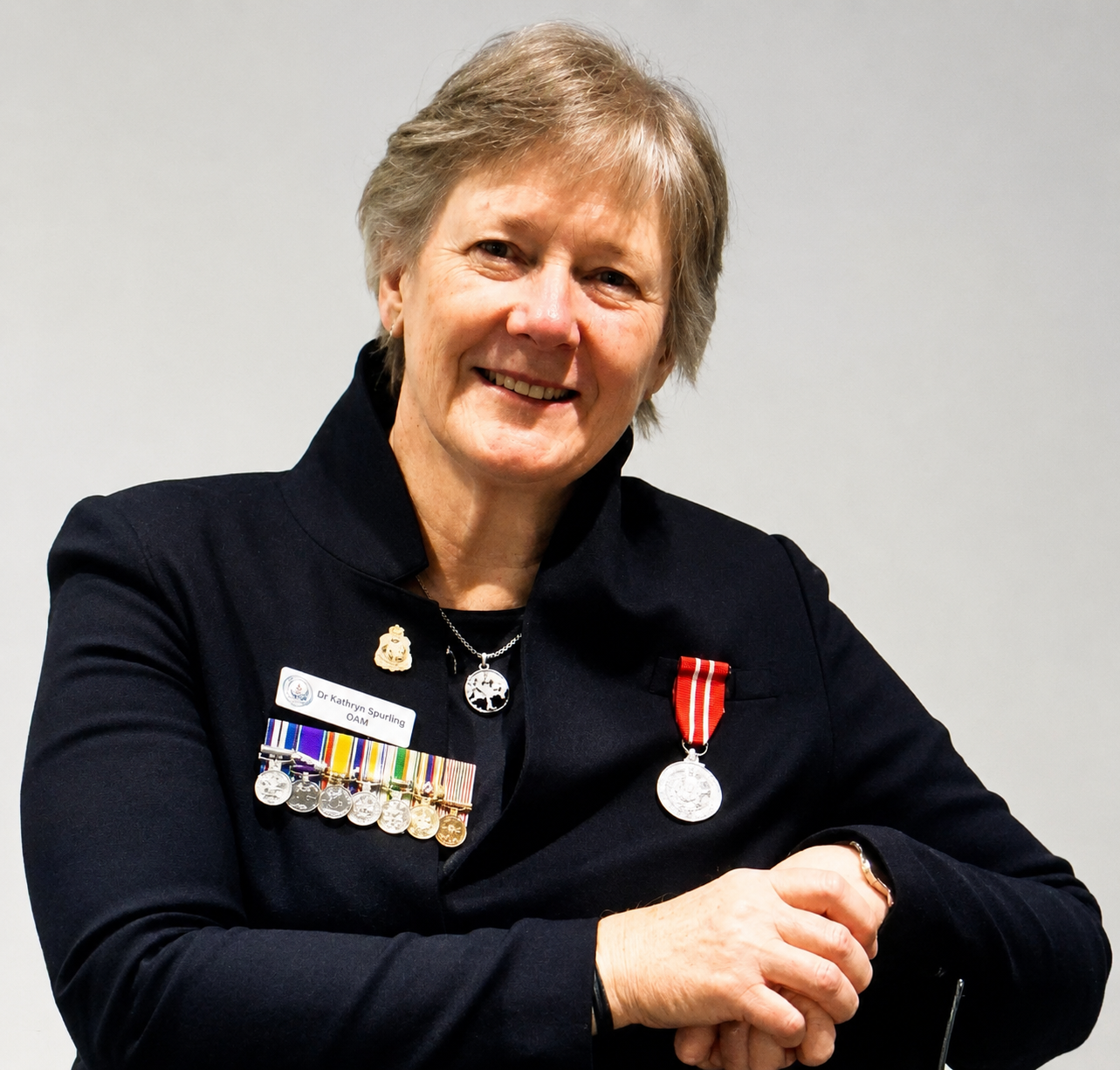
1966–1968Service
Women's Royal Australian Naval Service
Kathryn served in a navy where women were not permitted to deploy to sea, and where
the service of the WRANS was treated as the lesser contribution. Harassment was common
and rarely answered for. She has written since that she was one of those cases.
1996–1999The doctorate
The first woman to take a History PhD at ADFA
At the Australian Defence Force Academy she found a culture carried across largely
intact from the all-male Royal Military College, Duntroon. No woman had graduated with
a PhD in History there. She completed hers while tutoring, guest lecturing, founding the
ADFA track and field team and coaching its women's basketball side to a grade win in the
ACT competition.
Word got around that she was approachable, at a time when military staff and civilian
psychologists were considered compromised. Her office door opened to a great many young
women with accounts that were difficult to hear.
1998–2014Abroad
NATO, West Point, and the conferences that followed
Her writing on military culture took her to the lectern overseas more often than at
home. In 2000 she became the first Australian invited to speak at NATO
Headquarters in Brussels on women in the military, and the first Australian
Summer Military History Fellow at the United States Military Academy, West Point.
In 1999, over objections from within the ADFA hierarchy, she convened
Women in Uniform: Perceptions and Pathways — the first Australian conference to
address the service and conditions of women in the military, police and fire brigade.
2008–The books
Cruel Conflict, AE1, Montevideo Maru, Westralia
From her first book in 2008 she set out to tell the human side of war — not the people
who commanded, but the ones at the pointy end, commonly teenagers facing what nobody
should. Fire at Sea examined the graft, corruption and poor management behind the
deaths of four sailors aboard HMAS Westralia in 1998.
Her work has also gone well outside the services: a Queensland farmer defrauded by his
bank, and a four-year project on six Australian women who changed their fields, which
she published herself in 2013 after too many publishers passed.
AlsoThe eye
Gallery partner and collector
Having partnered in an art gallery and being an art collector, Dr Spurling also brings
valuable experience in evaluating artistic merit, originality and
craftsmanship — which is precisely why she is on this panel and not simply on
the letterhead.