
Since ancient times women have been involved in war, not just as victims, but involved in most civil and international conflicts. Mythology is invested with significant women warriors and leaders. ‘Neith’ was the Libyan goddess of the Pelasgian religion; her Sais palace guarded by armed virgin priestesses who fought to the death to become high priestess. Greek mythology depicted Pallas Athene; the archetypical warrior goddess dedicated to battle. Athene was depicted in Hellenic art wearing a warrior’s helmet, this insignia was adopted by the United States Women’s Auxiliary Army Corps (WAAC) during World War II (WWII).
Queen Semiramis of the Assyrians, according to legend, built Babylon, founded Nineveh and led the Assyrian army when it conquered Ethiopia, Egypt and Libya during the second millennium B.C. In the 15th Century B.C. Hatshepsut, Queen of Egypt, is believed to have commanded the Egyptian fleet into battle. Other women said to have led men into battle have included Queen Boadicea of Iceni; Queen Zenobia of Palmyra; even Catherine the Great of Russia.1
Women captained pirate and warships from 529BC until the early 1900s.2 Celtic women fought ferociously against the Romans; one Roman soldier described how:
You should see these viragos, neck veins swollen with rage swinging their robust and snow-white arms, using their feet and their fists and landing blows that seem triggered off by a catapult.3
In the West African Kingdom of Dahomey, in Benin, during the 19th century, women formed into a guard for the king.
Full-time professional women soldiers fought so ferociously and successfully for so many years that they eventually became the elite force of Dahomey’s professional, highly successful standing army.4
When France invaded Dahomey in the 1890s French officers declared how these women warriors fought to the death, and it was only the superior French weapons that prevailed during the bloody battles. The French gave the name ‘Amazons’ to the women warriors and this terminology was fixed to other corps of armed women.
Throughout Africa, South America and North America indigenous women took up arms during conflicts.5 There was no restriction on women joining frontline confrontations in rebel forces, and guerilla groups during civil upheaval. Thousands of women participated in direct combat during the Spanish Civil War. In 1983 the nation of Sri Lanka was torn apart by civil war between the Sinhalese-dominated Sri Lankan government and the Liberation Tigers of Tamil Ealam (LTTE). The war over ethnicity, land and power lasted until 18 May 2009 when the Sri Lanka Army gained control of the last territory and the LTTE Leader Velupillai Prabhakaran was killed. Whilst in 2006 it was estimated that within the official Sri Lankan Army of 100,000 there were around 5,000 women, including 500 officers. Within the LTTE one estimate was that 3,000 women were involved in direct armed conflict within the force of around 11,000.6 In 1988 women made up one third of Eritrean guerrillas fighting for independence in Ethiopia. The same year the Iranian opposition group, known as the Mujaheddin Combat Force opposed to Khomeini, was believed to have one third of their 15,000-armed force women. The women were segregated into their own brigades and identified by their bright red head scarves but participated in combat.
In western society, particularly those with strong religious foundations, armed forces became gradually more formalised and gendered. Mary Ludwig Hays, given the nickname Molly Pitcher, wore female clothes when she fought in the American War of Independence distinguishing herself at the Battle of Monmouth. The first woman awarded a disability pension by the United States Congress was Margaret Corbin. She
took over her fallen husband’s cannon in the Battle of Fort Washington during the American Revolution and was wounded in action.
It became increasingly common for women to fight disguised as men. Their exact numbers remained a mystery, because their subterfuge was only discovered if they were wounded. Deborah Sampson became a hero of the American Revolution disguised as Robert Shurtleff and fighting with the 4th Massachusetts Regiment. She earned a full military pension, published her memoirs in 1802 and conducted a public speaking tour. Women who chose not to accept their exclusion exhibited determination, fortitude, resilience, mental and physical courage.
Marie-Thérèse Figueur was permitted to enlist in the French Dragoons as a woman and served for 22 years under her own name during the French Revolution and Napoleonic Wars. Marie-Angelique Josephe Brulon, born in 1772, fought in male guise, became an infantry Lieutenant, revealed her identity, survived seven campaigns and was decorated with the Legion of Honour. Friederike Kruger, alias August Lubeck or Auguste Kruger, fought in the War of Liberation against the French with the 9th Prussian Regiment and was decorated with the Iron Cross and the Russian Order of St George. After retiring from the army, she married an ex-brother officer and in 1869 her grandson was commissioned in the same regiment in which his grandmother distinguished herself.7
Mary Dixson, described as a ‘strong, powerful woman’ served in the British infantry for over sixteen years, before being killed during the Battle of Waterloo.8 Christian ‘Kit’ Cavanagh joined the British Army as Christopher Welch and as an infantryman fought at the Battle of Landen. Discharged she promptly re-enlisted, this time as a member of the 2nd Royal North British Dragoons in 1697 and despite a musket ball in her upper thigh she fought at the Battle of Blenheim against the French. In 1717 her service was officially recognised, and she was given a British military pension. Hannah Snell took the name James Gray to serve in 1747 as a British soldier. She deserted to enlist as a Marine and sailed to the East Indies, participating in various sieges. During the Battle in Devicottail in June 1749 she suffered twelve wounds. To avoid detection, she removed a bullet herself.
Englishwoman Mary Anne Talbot assumed the guise of John Taylor and served as a soldier and sailor during the French Revolutionary Wars and was wounded for the second time on 1 June 1794 during the battle against the French fleet off Ushant.
During the Napoleonic Wars women served on English ships. An English Sergeant Major gave his account of the Battle of Waterloo in 1815 and mentioned that women died on the field, including a female French Hussars officer who was shot dead.
Many women were found amongst the slain although not of the same class as the heroine alluded to. … some were even mounted and rode astride.9
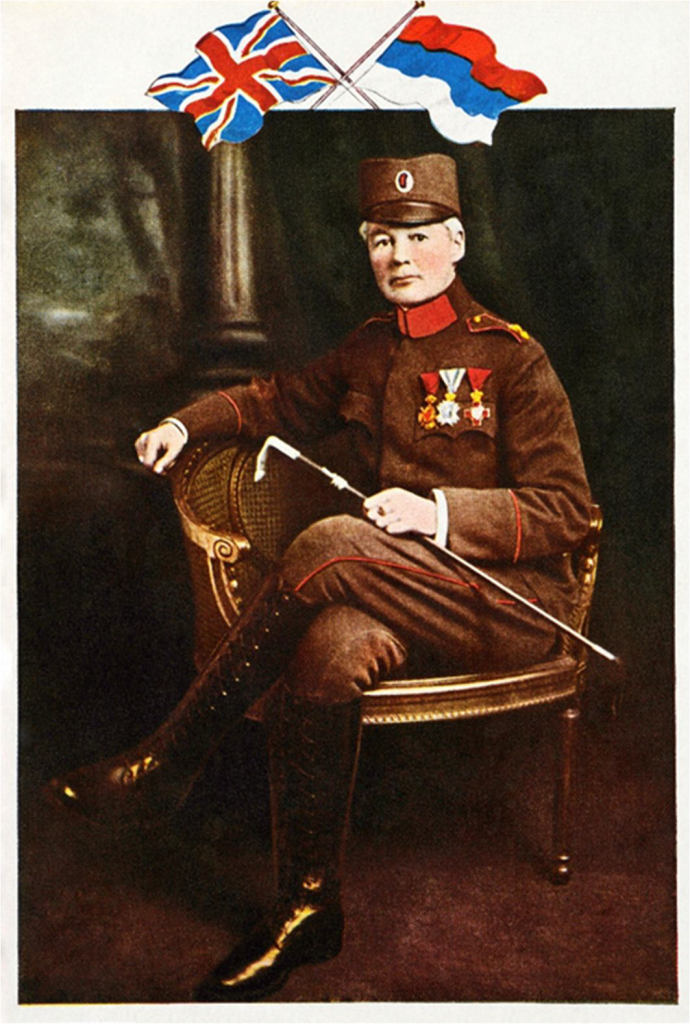
One of the most well-known in modern times was Englishwoman Sergeant (Sgt) Flora Sandes. Her sex was discovered when wounded while fighting on the frontline with the Royal Serbian Army during WWI. Recovered from her injuries she was permitted to return to direct combat and her service was officially acknowledged.10
Sandes undertook a speaking tour of Australia in 1920 and women ‘packed the halls.’11 The Australian media was aghast, particularly when she appeared at a Melbourne racetrack, wearing
uniform and smoking a cigarette. Their concern was that she might encourage Australian women to similarly ‘flaunt social conventions’.12 Sandes re-enlisted in WWII when Germany invaded Yugoslavia. The concern in 1920 that Sandes might encourage women to ‘flaunt social conventions’ was indicative of how tightly gendered
Australian society was. It could also be said that the women who ‘packed the halls’ to listen to this woman veteran speak, demonstrated a great curiosity in military service and the national mythology which had been denied them.